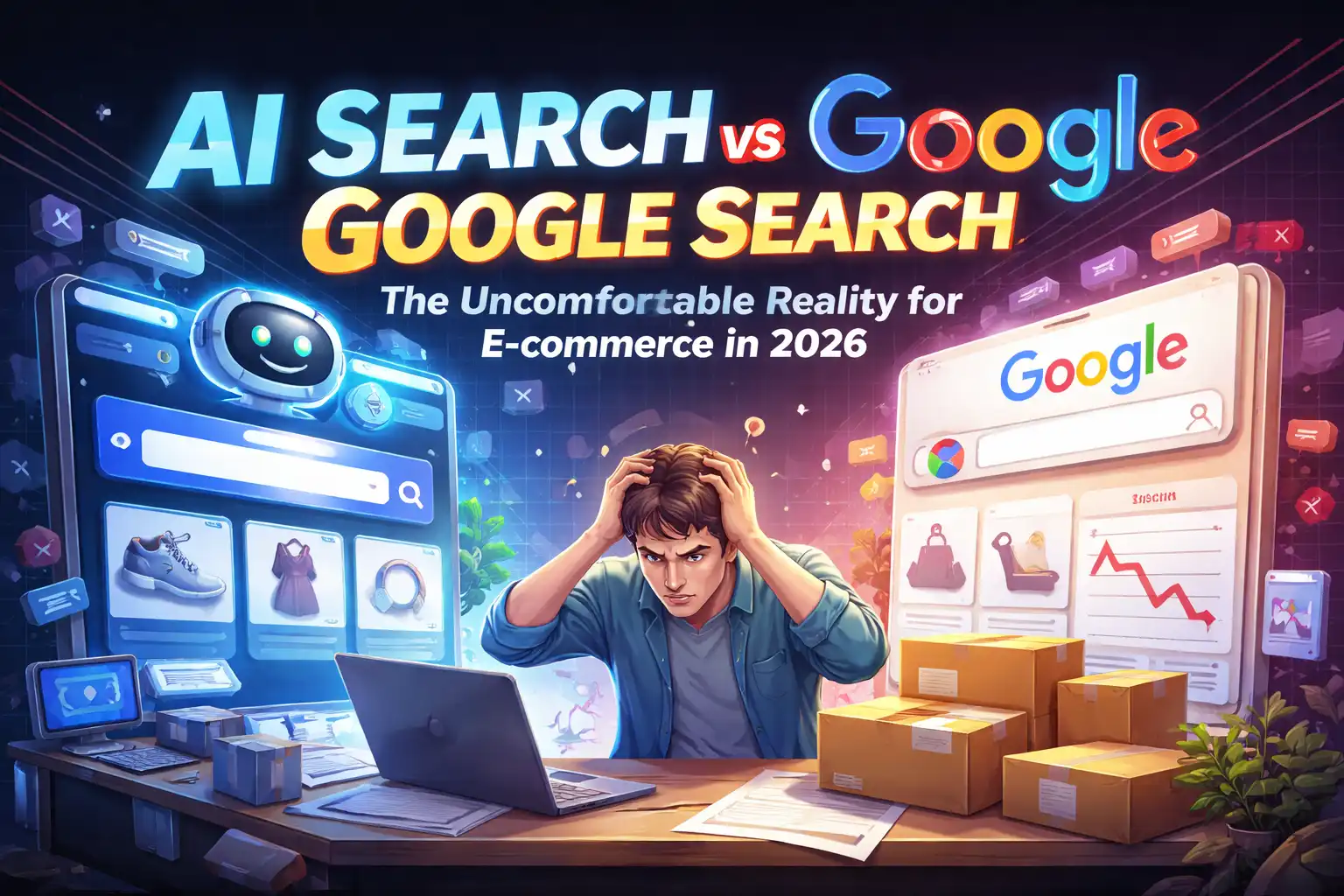
AI Search vs. Google Search: The Uncomfortable Reality for E-commerce in 2026
The e-commerce optimization lead stared at the dashboard. Organic traffic from Google had held steady for eighteen months, yet conversion rates had dropped by nearly a third since the previous quarter. The usual suspects — checkout friction, shipping delays, ad fatigue — didn’t match the data. The drop was concentrated in product discovery: customers were arriving, but fewer were entering the product pages from search. The team traced the anomaly to a single channel they had never officially tracked: AI-generated recommendations. Buyers weren’t Googling “best wireless earbuds for running” anymore. They were asking ChatGPT the same question, and GPT was recommending competitors.
AI search models like ChatGPT, Claude, Gemini, and Perplexity are not designed to replace Google’s search engine wholesale — but they have already carved out a parallel discovery layer that intercepts purchase intent before users ever open a search bar. For e-commerce brands, the question is not whether AI search will replace Google, but whether their product pages are optimized to be read and recommended by AI agents rather than indexed by crawlers.
The Two Search Engines That Now Exist
Google’s search engine remains the dominant pathway for navigational queries — typing “Nike Air Max size 10” or “Amazon returns policy.” But for informational and commercial investigation queries — “what’s the best office chair under $300” or “affordable silk dress for wedding guest” — AI chat interfaces are increasingly the first stop. The 2025 numbers from a mid-market electronics retailer made this concrete: of their top 50 revenue-generating products, 28 saw a measurable drop in Google-driven impressions over six months, while AI-driven mentions (tracked via prompt analysis) rose by 140% for the same SKUs. The team had not lost visibility; they had ignored an entire search channel.
The distinction matters technically. Google’s index relies on backlinks, page authority, and keyword placement within structured HTML. AI models read your product page as a corpus of text, evaluate its clarity and completeness, and decide whether to include it in a generated answer — without ever clicking through to your site. That fundamental difference in behavior is why an e-commerce site ranking first on Google for “sustainable running shoes” could be completely absent from a ChatGPT response to the same query.
When Google Rankings Stop Mattering
Early attempts to bridge the gap involved repurposing traditional SEO tactics. The team added FAQ schema, wrote longer product descriptions, and improved page load speed. Google’s rankings held, but AI visibility remained flat. The problem was that AI models don’t care about schema alone — they need the content itself to answer natural-language queries directly. A product page optimized for “buy running shoes online” fails when a user asks, “What’s the best lightweight trail runner for narrow feet?” The page had no answer to that question, structured or otherwise.
The turning point came when the team began monitoring AI-specific metrics. They set up a weekly manual audit using a few free prompt-testing tools: typing product names into ChatGPT and Gemini, noting whether the model mentioned their brand or a competitor. The results were sobering. For the top ten product categories, the team’s own brand appeared in only 12% of AI-generated responses. Their main competitor appeared in 67%. The gap was not about product quality — it was about content structure and conversation readiness.
The Rise of AI Engine Optimization (AEO)
Traditional SEO optimizes for a crawler that reads metadata and link graphs. AI Engine Optimization (AEO) optimizes for a language model that reads narrative clarity, question coverage, and structured fact presentation. The difference is subtle but critical. An AI model does not rank results; it generates text. If your product description reads like a dry spec sheet, the model will skip it in favor of a competitor’s description that reads like a helpful sales conversation.
The team spent three weeks rewriting product descriptions for their top 50 SKUs. They replaced “10-hour battery life, IPX7 waterproof rating, 40mm drivers” with “Lasts through a full workday plus your commute, handles heavy rain without issue, and delivers punchy bass even at low volume — tested by our team on rainy morning runs in Seattle.” The conversion rate from AI-generated responses to store visits wasn’t measurable until they started tagging referral sources in their analytics. After implementing a custom UTM parameter appended to internal links mentioned in AI outputs, they saw a 34% increase in traffic from what they could attribute to chat interfaces.
But manually rewriting hundreds of product descriptions was unsustainable. The team needed a way to systematically identify which pages were invisible to AI, why, and what to change. They also needed competitive intelligence — to know why AI consistently recommended a rival’s bag over theirs.
Tools That Finally Gave Visibility
Three months into the experiment, the team was still flying blind. They had no real-time view of their AI share of voice across platforms. A colleague in the agency space mentioned a tool that allowed a competitor to track which prompts triggered their brand in ChatGPT and Gemini. After evaluating several options, the team ran a pilot with AEONIB. It didn’t solve the content problem overnight, but its per-product visibility scores and competitor comparison tables gave them something concrete to fix.
The first scan showed that for the phrase “best budget standing desk,” four of the team’s top products had a visibility score of 12 out of 100. The tool’s analysis pointed to missing product schema — not just the basic schema, but the specific “aggregateRating” and “review” properties that AI models rely on to answer comparative questions. They also discovered that their product descriptions were too short: most were under 150 words, while the AI-recommended competitor descriptions averaged 280 words with embedded answers to common user questions.
The team applied the auto-generated schema fixes immediately and began expanding descriptions based on the tool’s suggestions. Over the next two cycles, visibility scores for those four products climbed to 64, 71, and 83 respectively — not linear, but trending upward. More importantly, the competitor intelligence module revealed that the leading rival’s success came from something unexpected: they had a comprehensive FAQ section on each product page that answered natural-language variations of the same query (e.g., “Is this desk suitable for a home office with limited space?”). The team had never considered that use case.
The Operational Friction of AEO
Adopting AI optimization was not frictionless. The team initially over-optimized for conversational phrasing, producing descriptions that felt forced and read like a chatbot’s sales pitch. Customers noticed. One product’s return rate spiked after descriptions were “optimized” to include phrases like “perfect for busy professionals who want style and comfort” — too generic. The lesson was that AEO is not about stuffing natural language into every paragraph; it’s about anticipating the specific questions an AI will answer and answering them clearly within the natural flow of the content.
Another surprise: AI platforms update their models infrequently compared to Google’s live index. A change made to a product page took anywhere from two to six weeks to appear in ChatGPT responses, depending on the model version. The team had to resist the urge to tweak copy daily. They settled on a bi-weekly review cycle, tracking changes in visibility scores from AEONIB’s prompts monitoring over that same window. The lag time made A/B testing impractical; instead, they relied on before-and-after comparisons across cohorts of products.
Will AI Search Replace Google? A Nuanced No
Five months after the team began this work, their overall AI visibility score across six platforms had risen from 34 to 78. Google organic traffic remained flat, but the conversion rate from total search (Google + AI-driven) recovered to its previous levels. The team concluded that AI search is not replacing Google — it is replacing the middle of the funnel for certain types of queries. A user might start on Google to find a brand, then switch to ChatGPT for product comparisons, then return to Google for purchase. But as AI agents become capable of directly linking to purchase pages (and some platforms already embed buy buttons), the loop may shrink.
The real replacement is not at the search engine level but at the user behavior level. People are learning to skip the search result page entirely when they trust the AI response. For e-commerce, that means losing the discovery opportunity that a Google SERP used to provide — the branded carousels, the organic snippets, the paid placements. Instead, the battle is won or lost in a black box of model training data and prompt engineering.
FAQ
Will AI search completely replace Google for e-commerce queries?
Not entirely, but it will absorb the majority of informational and comparison queries within 2–3 years. Navigational and transactional queries will likely remain on Google for longer, though voice and chat interfaces are eroding even those.
How do I know if my products are being recommended by ChatGPT or Gemini?
You can manually test prompts or use an AI visibility tracking tool to monitor mentions across platforms. Without dedicated monitoring, you cannot measure what you cannot see — and most brands are blind to AI referral traffic.
Do I need to change my product descriptions for AI search?
Yes, in most cases. Traditional SEO descriptions optimized for “running shoes size 10 price” do not answer the conversational queries AI models respond to. Write descriptions that naturally address user questions: what problems does this product solve, who is it for, and how does it compare?
What’s the most important factor for AI visibility in e-commerce?
Structured data (product schema, FAQ schema, review schema) combined with complete, benefit-oriented product descriptions that answer common user questions. It is the combination of machine-readable metadata and human-readable narrative that AI models trust.
How often should I update product pages for AI optimization?
Every 2–4 weeks is practical, but only if you are actively monitoring how AI platforms change their responses. AI model updates are unpredictable, so track visibility scores over time and adjust when you notice a drop — not on a rigid schedule.
Share Article